Insights

Every organization has managers who seem to get recognition right. They notice the effort behind an outcome, understand how individual employees prefer to be acknowledged, and connect contributions to the team’s goals.
Their teams are often engaged, productive, and easier to retain. When senior leaders see those results, they may view them as evidence that the organization’s approach to recognition is working.
But exceptional managers can create a strong experience even when the organization provides little structure or support. Their personal habits compensate for gaps in expectations, tools, and accountability. Because some employees feel valued, leadership may not realize how much the experience changes from one team to another.
The organization’s best managers are not causing its recognition problem. They may simply be making it harder to see.
Manager-led employee recognition can create false confidence
Managers have an enormous influence on the employee experience. Gallup has estimated that managers account for at least 70% of the variation in employee engagement across business units. Gallup
That influence extends to recognition. Managers are close enough to the work to understand the obstacles an employee overcame and acknowledge the contribution while it is still meaningful. A thoughtful manager can make employees feel valued without a formal process reminding them to do it.
An employee on another team may have a very different experience. Their manager may recognize only highly visible accomplishments, rely on generic praise, or assume dependable employees already know they are appreciated.
Both teams work under the same corporate values and may have access to the same recognition program. Yet the quality and frequency of recognition can vary dramatically.
This is the risk of relying too heavily on manager-led employee recognition. Leadership sees successful teams and assumes the organizational approach works. In reality, the strongest managers may be compensating for a lack of recognition consistency.
Companywide results can conceal recognition gaps
Organizations often evaluate recognition by looking at overall activity. They count awards issued, messages sent, points redeemed, or employees using a platform. Those totals show that recognition is happening somewhere. They do not show whether it is reaching employees consistently across managers, roles, locations, shifts, and work arrangements.
Companywide survey results can create the same blind spot. Positive experiences on some teams can offset weak experiences elsewhere and produce an average that appears acceptable.
Gallup and Workhuman studied more than 7,500 U.S. employees and found that only 26% strongly agreed they received a similar amount of recognition as colleagues with comparable performance. Gallup
Employees do not experience recognition as an organizational average. They compare what happens on their team with what they observe around them. When one manager regularly acknowledges meaningful contributions and another rarely does, employees can see the difference—even if both managers technically have access to the same tools.
Evaluating employee recognition across teams can therefore reveal a very different picture from companywide participation numbers. An organization may have significant recognition activity while still leaving meaningful recognition gaps.
The weakness appears when something changes
A manager-dependent approach may appear to work during a period of stability. Its fragility becomes clearer when the organization changes.
A strong manager is promoted. A team is reorganized. New locations are added. A manager inherits more employees and has less visibility into individual contributions. An employee transfers to another department and discovers that feeling valued was part of the previous manager’s leadership style—not the company’s culture.
The experience may deteriorate even though the organization’s values and programs remain unchanged. What appeared to be a cultural strength was actually being carried by particular people.
A useful test is to ask:
If one of our best people managers left tomorrow, would their team continue to experience the same quality of recognition?
If the answer is no, the organization may be relying more heavily on individual talent than leadership realizes. True recognition consistency should be able to survive a manager change, team transfer, or reorganization.
Inconsistency is not always a manager motivation problem
When recognition varies among teams, leaders may assume some managers care about employees while others do not. That explanation is simple, but it is not always accurate.
Most managers understand that recognition matters. They may still struggle to identify the right moments, find language that feels genuine, or maintain visibility across remote, deskless, shift-based, or distributed teams. New managers may be unsure what deserves acknowledgment. Operational leaders may naturally focus their attention on problems, deadlines, and exceptions.
These differences in manager recognition practices are not necessarily signs of poor intent. They may reflect differences in experience, confidence, access, workload, or visibility into the work.
Telling managers to “recognize more” does not resolve those differences. It can produce additional activity without improving the employee experience. Generic thank-you messages and recognition quotas may increase participation numbers while making appreciation feel less sincere.
Managers remain essential because they understand the employee and the context of the work. But a dependable approach cannot rely exclusively on their instincts. The organization must make good recognition easier without turning it into a script.
Look for variation, not just participation
The clearest sign of a recognition problem may not be low activity across the entire organization. It may be significant variation among teams.
HR can begin by examining whether employees’ perceptions of recognition differ materially by manager, role, location, shift, tenure, or work arrangement. A small number of managers generating a disproportionate share of recognition activity may also indicate that the broader approach is not taking hold.
Employee feedback can provide context that program data cannot. Do employees believe meaningful contributions are noticed? Does recognition feel sincere and fair? Would their experience change significantly if they moved to another team?
These questions help HR identify inconsistent employee recognition without reducing the issue to a manager scorecard. They also distinguish between having a recognition program and providing a dependable employee experience.
Determining where the differences exist is only the beginning. Closing recognition gaps requires decisions about ownership, manager support, accessibility, measurement, and the role rewards should play. Those elements belong within a broader organizational strategy.
Great managers should demonstrate the standard—not carry it alone
Exceptional managers offer valuable examples of what meaningful recognition can look like. Their habits and language can help the organization understand how effective recognition fits naturally into the flow of work.
But employees should not need an exceptional manager to feel valued.
The real measure of the organization’s approach is not whether some teams have an excellent experience. It is whether the company can create greater employee experience consistency across managers and work environments without losing the personal judgment that makes recognition meaningful.
The question is not whether your organization has managers who recognize employees well. It almost certainly does.
The more important question is whether those managers represent the culture—or are compensating for its gaps.
Key Takeaways
- Manager-led employee recognition can create a strong experience on individual teams while concealing broader inconsistencies across the organization.
- Companywide participation and survey results may hide recognition gaps among managers, locations, shifts, and employee populations.
- Great managers should help demonstrate effective recognition practices, but they should not be expected to carry the entire organizational approach.
Build a Recognition Experience That Does Not Depend on Chance
Would your employees continue to feel valued after a manager change, team transfer, or reorganization?
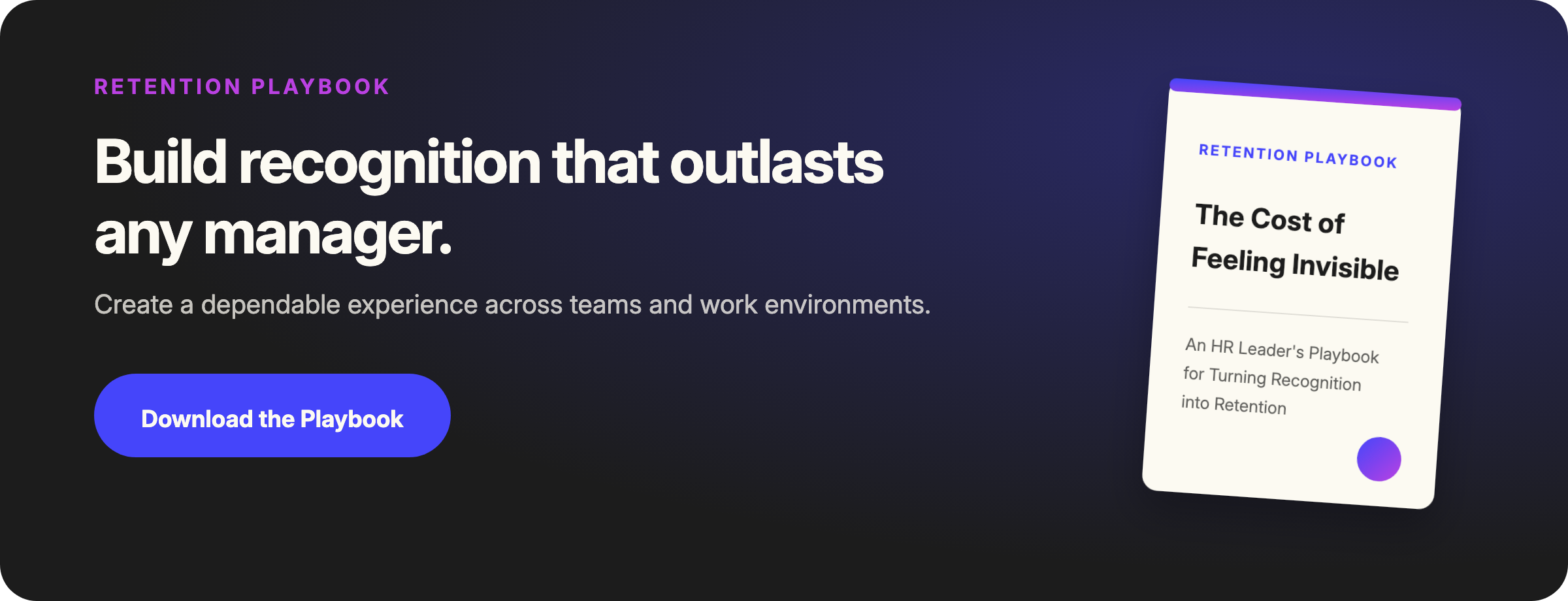
Download The Cost of Feeling Invisible: An HR Leader’s Playbook for Turning Recognition into Retention to identify where recognition is breaking down and build a more dependable experience across your workforce.
Frequently Asked Questions
What is manager-led employee recognition?
Manager-led employee recognition occurs when managers identify and acknowledge employees’ meaningful contributions. Managers are essential because they understand the work and the individual, but relying entirely on their personal habits can create significant differences among teams.
How can strong managers hide recognition gaps?
Strong managers may create meaningful recognition experiences even when the organization provides limited structure or support. Their teams’ positive experiences can make the overall approach appear more effective and consistent than it is.
Why does employee recognition vary across teams?
Recognition can vary because managers have different habits, experience levels, workloads, and visibility into employees’ contributions. Variations may also reflect organizational gaps in expectations, tools, access, and manager support.
How can HR improve recognition consistency?
HR can begin by comparing recognition activity and employee perceptions across managers, teams, roles, locations, shifts, and work arrangements. Significant differences can help HR determine where employees are being overlooked and where additional support or investigation is needed.